



Anthropic’s historic IPO highlights a critical business challenge of the AI era: how to turn rapid growth and massive investment into sustainable profitability.
On November 19, 2026, Anthropic — the company behind Claude — began trading on Nasdaq following the largest initial public offering recorded to date.
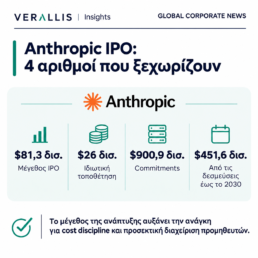
The IPO had a total size of $81.34 billion, at a valuation of approximately $1.5 trillion on a fully diluted basis. At the same time, a $26 billion private placement was completed, with participation from companies including Google, NVIDIA, AMD, Broadcom, Micron, Microsoft and TSMC.
However, the most interesting part of the story lies in the cost required to support this growth.
Commitments of nearly $901 billion
According to Anthropic’s official financial disclosures, the company has undertaken approximately $900.9 billion in purchase commitments and lease agreements, primarily related to computing capacity and associated infrastructure.
Of this amount, approximately $451.6 billion is expected to be incurred by the end of 2030.
This is not $900 billion in immediate investment, but rather long-term contractual commitments that generate significant future cash outflows and reduce financial flexibility. Anthropic itself acknowledges that meeting these obligations requires maintaining very high rates of revenue growth.
Three business takeaways
Growth is not a substitute for cost discipline
As a company scales, even relatively small improvements in procurement, commercial terms, resource utilization and operating expenses can have an increasingly significant financial impact.
Growth without equivalent discipline across the cost base can increase business risk rather than reduce it.
Supplier commitments create strategic risk
For Anthropic, access to compute is a critical production factor.
The company uses multiple architectures — including AWS Trainium, Google TPUs, NVIDIA GPUs and AMD GPUs — highlighting the importance of supplier diversification, strong commercial terms and flexibility in long-term commitments.
The real KPI is the return on committed spend
The critical question is not only how much capital a company can raise, but whether it can convert committed expenditure into corresponding revenue growth and sustainable returns.
Anthropic already has a strong commercial base, with thousands of large enterprise customers and a growing presence in organizations such as Barclays. The key question is whether this momentum can support the scale of its future commitments.
The VERALLIS perspective
Anthropic’s case is extreme in terms of scale, but the underlying principle applies to every business:
The faster a company grows, the more critical cost discipline becomes.
Active management of suppliers, contracts and operating expenses protects the operating margin and preserves financial flexibility.