



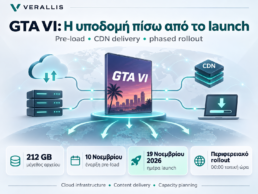
The launch of Grand Theft Auto VI was not only one of the biggest entertainment launches in history. It was also a massive operational challenge: how do you deliver a file of more than 200 GB to millions of users, almost simultaneously, without infrastructure becoming the point of failure?
On November 19, 2026, Rockstar Games released GTA VI for PlayStation 5 and Xbox Series X|S. Demand was already unprecedented before launch — Microsoft described it as the most pre-ordered game in Microsoft Store history.
For Rockstar and its technology partners, however, the challenge was not only to create the game. It was to ensure that millions of players could actually access and use it on launch day.
Preparation started nine days earlier
GTA VI required up to 212 GB of storage, depending on the platform. If all users had attempted to download that volume of data at the same time, the pressure on distribution networks would have been enormous.
Rockstar therefore opened pre-loading on November 10, nine days before the official launch.
Even physical editions did not include a disc, but rather a download code, allowing buyers to begin the preload before November 19.
This did not eliminate demand. It shifted it over time, spreading a significant share of downloads across several days.
On the first day of preload, game downloads through Amazon CloudFront reached 3.6 times the usual daily peak, remaining at highly elevated levels in the days that followed.
From a game launch to a global infrastructure event
Game delivery relied on Content Delivery Network infrastructure capable of bringing large files closer to end users.
Amazon reported that CloudFront handled the preload, full-game downloads and the day-one patch. At the highest point of the launch, game-download traffic reached approximately 4.1 times the normal daily peak.
The logic of a CDN is critical: instead of every download being served from a central origin, a large share of content is delivered through edge locations and caches closer to users’ networks.
The scale of the pressure was also visible across telecom networks. Comcast announced that GTA VI generated the two largest internet traffic days in the history of its network. At peak, the game accounted for up to 24% of total network traffic, while peak traffic was 31% higher than on an average day.
The rollout was not a single global switch
The game was released at 00:00 local time in each region, rather than simultaneously worldwide.
In practice, this transformed a potentially single global peak into a sequence of regional peaks, starting with New Zealand and followed progressively by Asia, Europe and the Americas.
At the same time, Microsoft added GTA VI to Xbox Cloud Gaming from day one, allowing even Xbox One users to run the game through cloud streaming rather than local processing.
Infrastructure planning therefore involved more than storage and downloads. It covered multiple delivery channels: local installation, CDN distribution, patches and cloud gaming.
Three business takeaways
1. Managing the peak starts before the peak appears
Preloading is a clear example of demand shaping.
Rather than relying exclusively on additional infrastructure to absorb an extreme demand spike lasting only a few hours, part of the demand was shifted into the preceding days.
For businesses, the principle is broader: the best solution to a capacity problem is not always more capacity. It can also be better demand planning.
2. The ability to scale depends on the entire supplier ecosystem
Rockstar could create the product, but the customer experience at launch also depended on Microsoft, Sony, cloud providers, CDNs and ISPs.
In large-scale digital operations, business resilience is only as strong as the infrastructure of its critical suppliers.
Partner selection, available capacity and the ability to scale rapidly are therefore business continuity decisions, not simply IT decisions.
3. Preparation does not mean zero problems
Even with extensive planning, the launch was not technically flawless.
On November 23, Rockstar issued an update addressing several issues that caused crashes and other gameplay problems.
The lesson is not that the right infrastructure eliminates operational risk.
It is that it reduces the probability that a predictable spike in demand becomes a systemic failure and enables faster recovery when problems occur.
The VERALLIS perspective
The GTA VI case shows that a successful launch requires far more than the product itself.
Capacity planning, supplier readiness, cloud infrastructure, distribution strategy and contingency planning must be designed before demand materializes.
For a business, the right question is not only how much its infrastructure costs, but whether it can perform when real demand tests its limits.